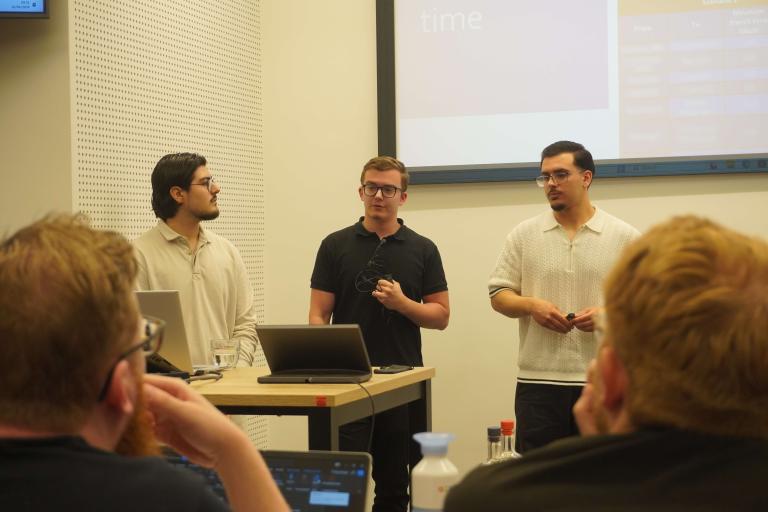
Connecting Academic Talent with Real-World Logistics Challenges
How do you make an existing supply chain more sustainable without compromising cost or performance? That's the challenge Ahlers presented to students from the Supply Chain Bachelor's program at Artevelde University of Applied Sciences in Ghent as part of a collaboration with the university.
As part of the project, Ahlers shared two real customer cases and invited students to analyze existing multimodal transport routes with the objective of identifying opportunities to optimize costs, improve operational efficiency or reduce CO₂ emissions.
The assignments were developed by Sustainability Advisor Katrien Van Itterbeeck, Operations Director John Ots and Operations Manager Central Asia Vyacheslav Koltyshev. They selected two vastly different transport flows from Ahlers' customer portfolio: a mature consumer goods lane with containerized cargo and a complex project cargo route to Central Asia, where oversized cargo, permits and multimodal transport create extra operational challenges.
«We see a growing interest from our customers in sustainability, so we're constantly looking for ways to optimize transport,» says Bart van der Weken, Global Key Account Manager. «The students started by interviewing us to understand the customer, the cargo, the route and the bottlenecks before developing their first proposals.»
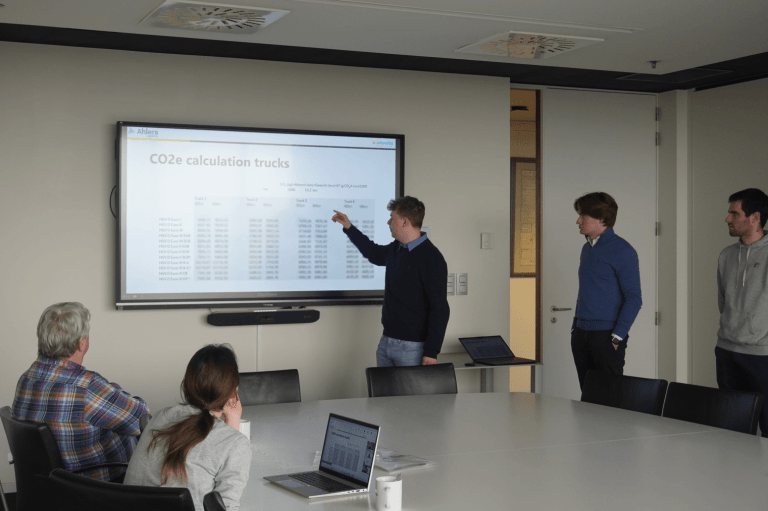
«It all sounds very easy, but then you have to figure out where to get the data and where to begin,» says Yonis Al Kasem, who worked on the consumer goods case. As part of the sustainability analysis, the students went beyond using standard emission calculators. Guided by the Ahlers sustainability team, they applied the GLEC Framework and developed detailed emission calculations tailored to various transport modes and scenarios.
The collaboration generated valuable insights for both cases. For the consumer goods route, the analysis confirmed that the existing solution is already highly competitive while highlighting several optimization opportunities worth further evaluation. For the project cargo case, the students concluded that the current routing remains the most efficient option, but also identified opportunities to optimize certain elements. To support future analyses, they developed an extra solution. «We created an Excel tool where Ahlers can compare different transport options based on cost, time and emissions, and ultimately suggest the most optimal option,» explains Arthur Meuleman.
The findings will now be reviewed internally and considered for new optimization initiatives. «Now that we have the results, we'll analyze them internally and see how we can transform these suggestions into proposals for our customer,» says Bart van der Weken.
For the students, the project was an opportunity to step into the world of logistics beyond the classroom. They experienced first-hand that optimizing a supply chain is rarely about finding one simple solution. Every decision involves balancing costs, transit times, emissions and operational constraints. At the same time, they enjoyed exploring international logistics and discovering the complexity of a region like Central Asia.
Beyond the practical outcomes, the collaboration offered students a chance to experience the complexity and variety of modern logistics before starting their careers. «I'm really happy to see these seven motivated, smart young professionals choosing logistics,» says Katrien Van Itterbeeck. «I can't wait to see the impact they will have.»